Sylvie
Cartes Postales from GreeceSylvie’s honeymoon with Jean-Luc becomes a story of perception overturned: what first appears to her as charming rustic decay belongs to a village whose past and customs carry a deadly threat. Separated from her husband while trying to escape, she sustains a serious injury and reaches help, but her account is met with suspicion. The story leaves her fate entangled with the village’s silence and with the loss of the wedding ring that once marked her new marriage.
Identity and Introduction
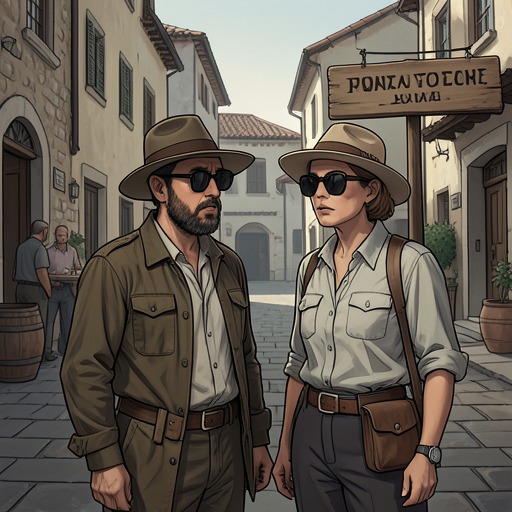
Sylvie appears as a newly married woman travelling with her husband, Jean-Luc. Their journey initially invites the language of romance and picturesque discovery. When they pass an old stone house, she admires its creeper-covered walls and imagines it as a beautiful cottage. Her response is sincere, but it rests on what a visitor can see: she has no knowledge of the vendettas, deaths, or tragedies that may have left such buildings derelict.
The narration sets her eye for beauty against the history concealed by the landscape. Even wrecked wooden boats, once left to be repaired, appear delightful in the sunshine; Sylvie likens one to a fish skeleton and finds it almost sculptural. Her delight establishes the gap between the honeymooners’ romantic reading of their surroundings and the violence that will soon make those surroundings dangerous. The contrast does not make her appreciation false; it shows how little a picturesque surface can reveal to a visitor.
The Honeymoon Turns to Confinement
When the couple need somewhere to stay, Sylvie notices that the general store is still lit and proposes asking its owner about a room or petrol. The owner is at the till and seems to have been expecting her. That detail lends the encounter an ominous undertone in retrospect, though Sylvie approaches it as a practical attempt to solve their immediate problem.
Later, while Jean-Luc works for an hour and a half on a file and the mechanism of a locked door, Sylvie waits on her bed, turning her wedding band round and round. The ring is a small, physical expression of the marriage that brought them on this journey, and her nervous movement gives the waiting a sharply personal focus. When she hears the mechanism give and the door begin to open, she leaps up with excitement. Her hope collapses when she sees bars across the opening, slid into place against the wall after the door was shut. The apparent solution has revealed another barrier.
Escape and Injury
Jean-Luc urges Sylvie to climb through a narrow opening above them. She hesitates, telling him she cannot do it, but his appeal to try for both of them persuades her. With all her strength, she hauls herself up and disappears into the darkness, leaving him alone in the cell. He calls after her and receives no answer. On the other side she falls headfirst onto a balcony, where two plastic chairs soften the impact, though she is winded and bruised.
Alone outside, Sylvie tells herself to be brave because Jean-Luc is relying on her. It is dark, the street below is empty, and the houses are unlit. She calculates that she can move along a row of balconies and descend to the street, then find a route back to him. The plan turns her escape into an effort to return, not simply to save herself. Winding streets offer no clear logic, but she reasons that following a gradual downward slope will eventually lead to the sea.
A chained dog rushes at her from the shadows and stops short; frightened, she continues with her heart pounding. Then she trips over a low bollard. She breaks her fall with her hands, lands hard on her knees, and breaks her left wrist. As the wrist swells and her fingers stiffen, she removes her wedding ring just before she can no longer get it off and puts it in her jeans pocket. The gesture preserves the ring temporarily, but not the security it signifies: somewhere in the hours that follow, it disappears. Bleeding from a tear in her jeans, with a badly cut knee, she tries to stand and has to sit again, overcome by pain, nausea, and frustration.
Her Account and Its Aftermath
The locked jeep offers no escape, and it has no petrol. Around four in the morning a truck passes without stopping. At daybreak, a farmer gives Sylvie a lift to a larger town fifty kilometres away; without a shared language, he understands only that her car has broken down and her wrist is cracked. At the hospital, a doctor who speaks French helps her relay what happened. Sylvie is hysterical and almost incomprehensible, but the doctors and nurses gathered around her nod as they listen. They know the village’s reputation: in past centuries, its inhabitants marked Easter Saturday by hanging a criminal, and that tradition has been reinstated. They understand that Sylvie and Jean-Luc arrived at the wrong place at the wrong time and had unknowingly intruded upon one of the village’s unwritten laws.
That recognition does not protect her from investigation. There is no corpse, evidence, or witness to support her story, and the missing wedding ring counts against her: investigators and local people treat its loss, only days after the wedding, as possible evidence of a terrible quarrel. The police and residents close ranks. In the end, the absence of a body prevents murder from being proved, but it does not resolve what happened to Jean-Luc or establish Sylvie’s account in court.
The Greek press briefly fixates on the case, then forgets it after the trial. Later, two plain wedding bands appear in the general-store window, nestled among plastic combs and a cracked Patek Philippe. Their appearance recalls the ring Sylvie lost and the marriage disrupted by the village, but the narrative does not confirm who placed them there or establish their owners. Sylvie’s arc thus closes not with a clear reunion or explanation, but with an unresolved image: wedding bands displayed as ordinary merchandise in the very village whose hidden violence transformed her honeymoon.